
How Many Rolls Fit in a Container? A Loading Guide for Agricultural Film Buyers
By JEDIRO Team
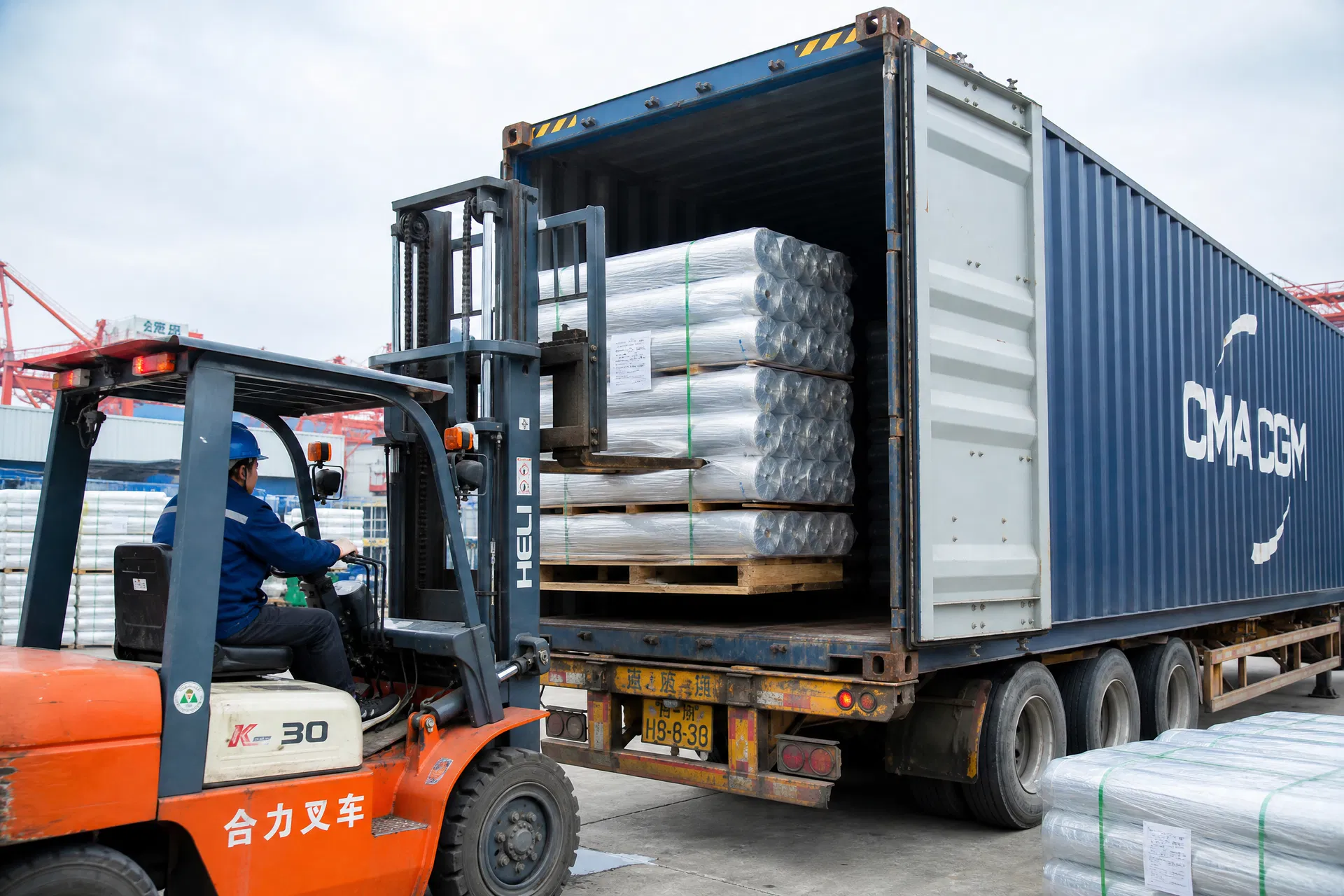
Freight is one of the largest single line items in the landed cost of imported agricultural film. On a low-value-density product shipped halfway around the world, the difference between a well-planned container and a poorly planned one can move landed cost per roll by several percent — and a container that leaves with unused capacity is money that cannot be recovered.
Yet most buyers request a price per roll and let the supplier decide the loading. This guide covers the math so you can plan the container yourself.
The four numbers you need
Whatever the product, container planning reduces to four figures. Get these from your supplier before discussing price:
- Rolls per pallet — the stacking configuration, including whether rolls stand upright or lie horizontally
- Pallet footprint and gross pallet height — a 1.2 × 1.0 m pallet and a 1.2 × 0.8 m pallet give very different container counts
- Pallets per container, stated separately for 20 ft and 40 ft
- Net and gross weight per roll — net for your usage math, gross for the weight limit
A supplier who can produce all four immediately has shipped the product regularly. A supplier who has to calculate them for you has not.
Worked example: cotton wrap film
Cotton wrap film is the heaviest of the three common agricultural films on a per-roll basis, so it makes a good worked example. A standard 108-inch roll is 2.743 m wide × 504 m long with a net film weight of 100 kg.
| 20 ft container | 40 ft container | |
|---|---|---|
| Rolls per pallet | 9 | 9 |
| Pallets per container | 14 | 24 |
| Rolls per container | 126 | 216 |
| Net film weight | ~12.6 t | ~21.6 t |
| Modules covered | 3,024 | 5,184 |
That last row is the one that matters for inventory planning. At 24 modules per roll, a 40 ft container of cotton wrap film covers roughly 5,200 modules, or about 2,500 acres at 2 bales per acre. Sizing your order from acreage in your territory is far more reliable than sizing it from last year's roll count.
Volume or weight — which one binds?
This is the question that separates buyers who plan containers from buyers who accept them.
Most agricultural film is volume-limited: you run out of cubic space long before you approach the container's payload ceiling. Cotton wrap film is the exception. A full 40 ft load of 216 rolls carries approximately 21.6 t of net film, and once pallets, packaging and cores are added the gross figure climbs further. Depending on the container's tare weight and the road weight limits in your destination country, that can approach the practical payload ceiling.
The practical implications:
Check destination road limits, not just container limits. A container that is legal on the vessel may exceed axle weight limits on the road leg. In parts of Europe and Australia this regularly forces a reduced load, and discovering it after the container has been stuffed is expensive.
Do not mix heavy and light film without calculating. If you are consolidating cotton wrap film with a lighter product in one container, load the heavy product to a calculated weight rather than filling the floor and adding lighter product on top.
Ask for the gross weight, not the net. Net film weight excludes cores, stretch hood, pallets and dunnage. On a 216-roll load the difference is not trivial.
Why the math differs across products
The three films behave very differently in a container, and a loading plan that works for one will waste space on another.
Cotton wrap film ships as a small number of very large, heavy rolls. The 2.743 m roll width means pallets are effectively single-roll-wide in one dimension, so the loading configuration is largely fixed by the product geometry. There is little optimisation available — the numbers are what they are.
Bale net wrap ships as a much larger number of smaller, lighter rolls, usually palletised upright. Roll length varies widely between products, so a "rolls per container" figure is meaningless without the roll length attached to it. Two suppliers quoting the same rolls-per-container number can be shipping substantially different quantities of net.
Silage wrap film varies more than either, because roll width, length and micron all move independently. A container of 25 µm film and a container of 50 µm film at the same roll dimensions differ by roughly double in weight and in the area of bale surface they will cover.
The comparison that actually matters is not rolls per container. It is:
- For net wrap: metres of net per container, or better, bales wrapped per container
- For silage film: square metres of film per container, or bales wrapped per container at your layer count
- For cotton wrap: modules per container
Ask every supplier to quote on that basis and quotations become directly comparable, regardless of how they have configured their rolls.
20 ft or 40 ft?
The freight cost of a 40 ft container is typically well below double a 20 ft, so cost per roll almost always favours the larger box. For cotton wrap film the ratio is 216 rolls against 126 — roughly 1.7× the quantity — which usually more than offsets the freight differential.
The arguments for a 20 ft container are inventory arguments, not freight arguments:
- First order from a new supplier. A smaller commitment while you evaluate quality is worth paying a premium for.
- Limited warehouse space or handling equipment. A 100 kg roll needs appropriate handling gear; 216 of them need somewhere to go.
- Weight-limited destinations, where a 40 ft container of heavy film cannot be legally moved on the road leg in one piece.
- Season timing. Splitting a season's requirement across two 20 ft containers arriving four weeks apart costs more in freight but reduces the risk of the whole season's supply sitting on one vessel.
Loading and condition checkpoints
Container capacity is only useful if the film arrives in usable condition. Before shipment, agree the following in writing:
Pallet quality and treatment. Confirm ISPM 15 heat treatment for wooden pallets. A rejected consignment at the destination port over untreated wood is a costly and entirely avoidable problem.
Roll orientation and edge protection. Film rolls damaged on the edge are unusable in a wrapper even when the bulk of the roll is fine. Confirm whether rolls ship upright or horizontal and what edge protection is applied.
Load restraint. Rolls that shift in transit deform. Ask what dunnage or airbag arrangement is used, particularly for a partially loaded container.
Container inspection. For products stored outdoors afterwards, a container with a damaged roof or a history of chemical cargo is a real risk. Request container number and condition photos at stuffing.
Loading photos. A short photo set at stuffing — pallets on the floor, mid-load, and doors before closing — costs the supplier nothing and settles most subsequent disputes.
Frequently Asked Questions
Featured Product
Ready to Plan Your Container Order?
JEDIRO ships cotton wrap film, silage wrap film, and bale net wrap from Qingdao and Shanghai. Get a loading plan and FOB quote for your specification.
Related Articles


Share this article
JEDIRO Team
We manufacture bale net wrap, silage wrap film, and cotton wrap film for global agricultural markets. Learn more about us →