
ASABE S615 Explained: What the Cotton Module Wrap Standard Actually Requires
By JEDIRO Team
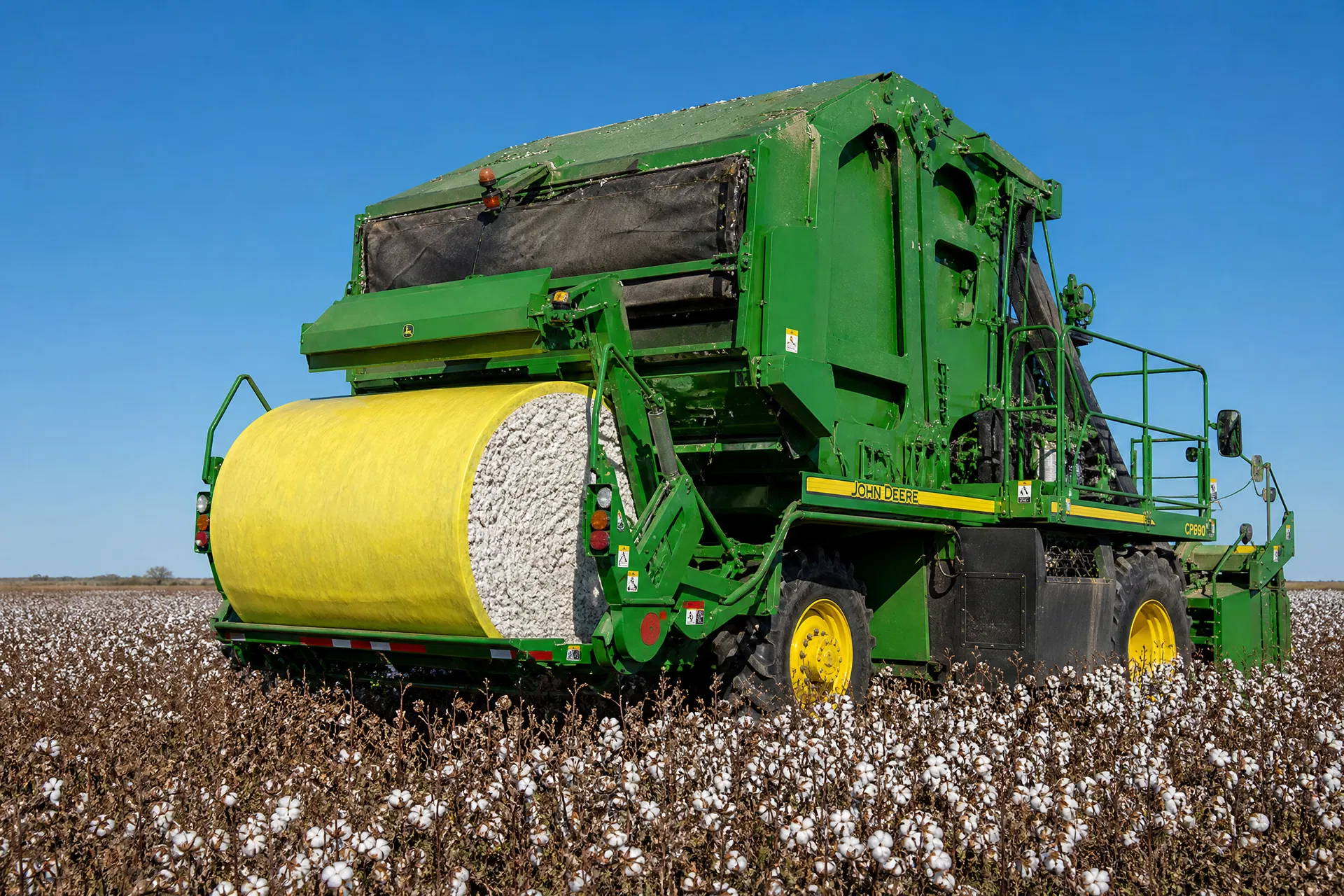
"Meets ASABE S615" appears on a lot of cotton wrap film datasheets. Very few buyers know what sits behind that sentence — which tests were run, what numbers had to be hit, and whether a claim on a spec sheet means anything at all without supporting documentation.
This guide walks through what the standard actually requires for round module wrap, so you can read a supplier's claim critically.
What S615 is, and what it is not
ASABE S615, Cotton Module Cover Material Performance, is a consensus standard developed by the Cotton Engineering Committee of the American Society of Agricultural and Biological Engineers. It was first adopted in 2012 for rectangular module tarps, revised in 2013, reaffirmed in 2018, and then substantially revised in February 2022 as S615.2 — the revision that added performance requirements for round (cylindrical) module wrap. The current edition is S615.3, published November 2024.
Two things buyers should understand about its legal status:
It is voluntary. ASABE standards are advisory documents. No U.S. law requires a wrap product to comply, and compliance does not by itself guarantee conformity with any other regulation.
It is enforced commercially, not legally. The National Cotton Council maintains a published list of Approved Round Module Wrap Products for wraps that have demonstrated compliance. Gins and producers increasingly treat presence on that list as a purchasing condition, which gives the standard real weight in the U.S. market even though nothing legally compels it.
The stated purpose of the round module section is twofold: protect stored seed cotton from quantity and quality loss, and reduce plastic contamination in ginned lint bales. The second objective is what drives several of the more unusual requirements, particularly the color rule.
Round module wrap vs rectangular tarps — different tests entirely
S615 covers two very different products under one document, and the requirements do not overlap.
Rectangular module tarps are multi-season products. The dominant failure mode is wind-driven mechanical flexing degrading water resistance, so the standard subjects samples to 12,000 flex cycles on a Gelbo flex tester and then measures water penetration. "Acceptable" and "Superior" grades are defined by how many specimens pass.
Round module wrap is a single-use film applied under tension by the harvester. Wind degradation is not the primary concern. Instead the film must resist puncture, tear and impact while providing enough structural stability to hold the module in cylindrical shape for months.
If you are buying film for a CP690, CS690 or CP770, only the cylindrical requirements are relevant to you.
The five laboratory tests
Testing is performed on a hand-layered composite representing the zone of the applied cover with the fewest film layers — not on a single ply. This matters: a supplier quoting a single-layer figure is not answering the question the standard asks. Where an applied wrap produces both a three-layer and a four-layer zone, the three-layer zone is what gets tested.
A minimum of five manufactured covers, preferably from different production lots, must be sampled, and testing must be carried out by an independent qualified laboratory.
| Test | Method | Measured in |
|---|---|---|
| Tensile strength and elongation | ASTM D882 | Module circumference and module axis |
| Tear-propagation resistance | ASTM D1938 (trouser tear) | Both directions |
| Puncture-propagation tear resistance | ASTM D2582 | Both directions |
| Impact-puncture penetration resistance | ASTM D3420, Procedure A | — |
| Thickness | ASTM D6988 | Composite |
Threshold values
The standard sets two levels for each test: a Group threshold the mean of all sampled covers must meet, and a Single threshold each individual cover's mean must meet. Both have to be satisfied. Group values for the S615.2 round module section are:
| Characteristic | Circumference direction | Axis direction |
|---|---|---|
| Tensile maximum load | 151 N | 162.4 N |
| Elongation | 716% | 835% |
| Tear-propagation max load | 22.4 N | 25.5 N |
| Puncture-propagation resistance | 161.8 N | 167.4 N |
| Puncture tear length (maximum) | 53.9 mm | 52.0 mm |
| Impact-puncture resistance | 4.23 J | — |
| Composite thickness | 219 µm | — |
Two observations worth internalising:
The thickness figure is a composite, not a ply. A 219 µm minimum across the minimum-layer zone means a film wrapping to three layers needs roughly 73 µm per ply. If a supplier quotes you a per-layer thickness in the 20–30 µm range for cotton wrap, either the figure belongs to a different product or the wrap cannot meet the standard.
Elongation requirements are extremely high. Requiring 716–835% elongation rules out stiff, highly filled formulations. The film has to stretch substantially before failing, because that is what allows it to absorb handling impact rather than tear.
The color requirement — the rule most buyers miss
S615 explicitly prohibits round module wrap in clear, white, tan, brown or black. This is not aesthetic. Gins run color imager–based detection systems to find plastic fragments in flowing seed cotton, and those colors sit inside or too close to the natural cotton color space to be detected reliably. A white wrap fragment entering a bale is effectively invisible until it shows up as a contamination claim on the other side of the world.
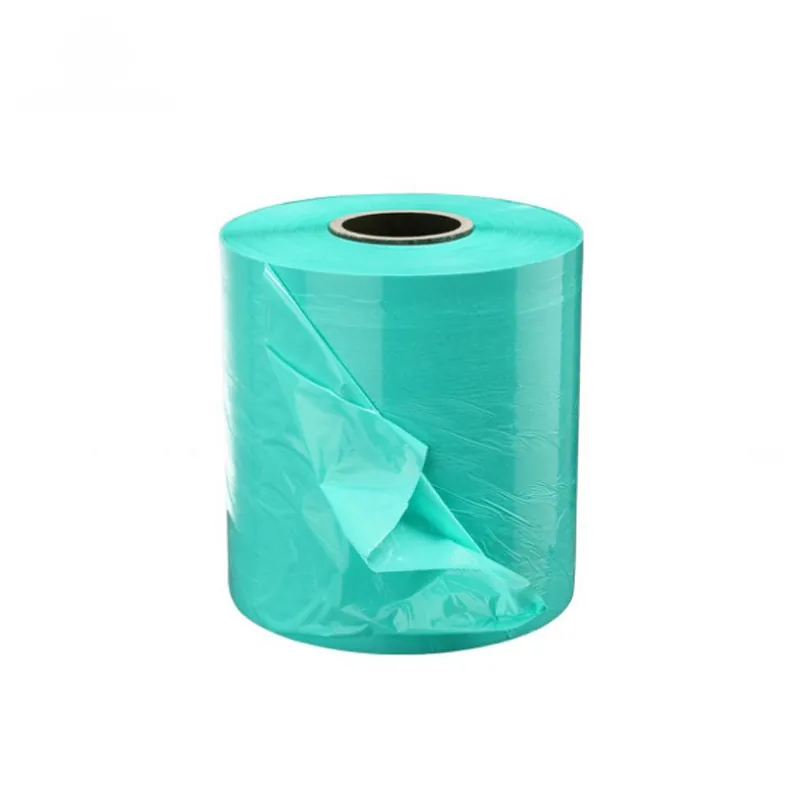
The recommended color is a high-saturation cyan/blue, defined in CIELCH terms as L = 68.42, C = 40.14, H = 235.94°. Any color other than the five prohibited ones is allowable, which is why yellow round module wrap is common and compliant while white is not.
There is also a fade requirement: color must be measured at the start of field testing and again after six months, and must not shift by more than ΔE = 2.0 under CIEDE2000. This is a UV stability test wearing a color-science costume — a film with inadequate UV inhibitor package will fail it.
The six-month field trial
Laboratory results alone do not achieve compliance. The standard requires an in-field program that most buyers are unaware of:
- At least 24 modules formed and wrapped by a properly equipped harvester at maximum diameter setpoint
- Average measured module diameter of at least 239 cm
- Stored outdoors for six months on a prepared, well-drained surface with full sun exposure
- Modules oriented so the adhesive tails receive maximum sun exposure
- Inspected weekly for the first two months, then at least monthly
Testing must be conducted in an environment matching the intended market. The standard defines two: Environment A (cold to moderate, −12°C to 38°C, comparable to Lubbock, Texas) and Environment B (moderate to warm, 8°C to 38°C, comparable to Stoneville, Mississippi). A wrap intended for all climates must be tested in both. A supplier claiming universal suitability from a single-environment trial is overstating its data.
Five failure modes are tracked, with these pass levels:
| Failure mode | Allowed |
|---|---|
| Minor tail adhesive separation | ≤10% of modules |
| Major tail adhesive separation | ≤10% of modules |
| Breaks in cover material | ≤10% of modules |
| Adhesive slip | ≤10% of modules |
| Cover system failure | Zero modules |
| Module squat ratio | ≤1.07 |
The zero-tolerance line on cover system failure — the tail completely separating, or seed cotton becoming exposed around the circumference — is the strictest requirement in the standard, and the one most directly tied to real financial loss.
Squat ratio deserves a note. It is the horizontal diameter divided by the average of horizontal and vertical diameters, measured on both flat faces after ejection and again after two months of storage. A ratio above 1.07 means the module has slumped, which indicates the wrap is not holding tension. Slumped modules shed water poorly and are difficult to handle at the gin.
Cylindrical module cover test results remain valid for five years, provided nothing about the material or the cover system design changes.
What to ask a supplier
A datasheet line saying "ASABE S615 compliant" is unverifiable on its own. Ask for:
- A Certificate of Analysis naming the manufacturing facility, its physical address and country of origin, and the manufacturing date. For imported wrap, the importer is responsible for obtaining and holding the COA from the foreign manufacturer.
- The name of the independent testing laboratory and the date of testing.
- Which field environment was tested — A, B, or both — and whether the six-month trial was completed or is still in progress.
- The composite thickness figure and the number of layers in the tested zone, not a per-ply thickness.
- Whether the product appears on the NCC Approved Round Module Wrap Products list, which is publicly checkable and settles the question immediately.
It is also worth asking about ASABE S647, the Seed Cotton Module Identification System standard covering RFID designations for round module wrap. S647.1 was published in January 2025 and includes updated manufacturer designations for wrap producers that have entered the market since the original version. If your gin uses RFID module tracking, wrap without a correct manufacturer designation creates reconciliation problems downstream.
The full text of S615 is published free of charge by ASABE with support from the National Cotton Ginners Association, and is worth reading directly before any large purchase.
How this maps to product specifications
When comparing quotations, the standard gives you a structure that cuts through marketing language. Tensile and tear figures must be stated directionally — circumference and axis — because the film behaves differently in each. UV rating must be tied to a stated outdoor storage period. Adhesive formulation must be matched to the harvest climate, since tail adhesive slip is one of the five tracked field failure modes and is heavily temperature-dependent.
JEDIRO publishes directional tensile, tear resistance, UV rating, adhesive formulation options and harvester compatibility for its 108-inch cotton wrap film so buyers can compare against these criteria line by line rather than against a single headline number.
Frequently Asked Questions
Featured Product
JEDIRO Cotton Wrap Film
108-inch (2.743m) width · Directional tensile and tear data available · Yellow and blue for US gin delivery · Adhesive formulation options for Environment A and B.
Related Articles


Share this article
JEDIRO Team
We manufacture bale net wrap, silage wrap film, and cotton wrap film for global agricultural markets. Learn more about us →