
Hay Tarp Size Guide: Measuring Round and Square Bale Stacks
By JEDIRO Team
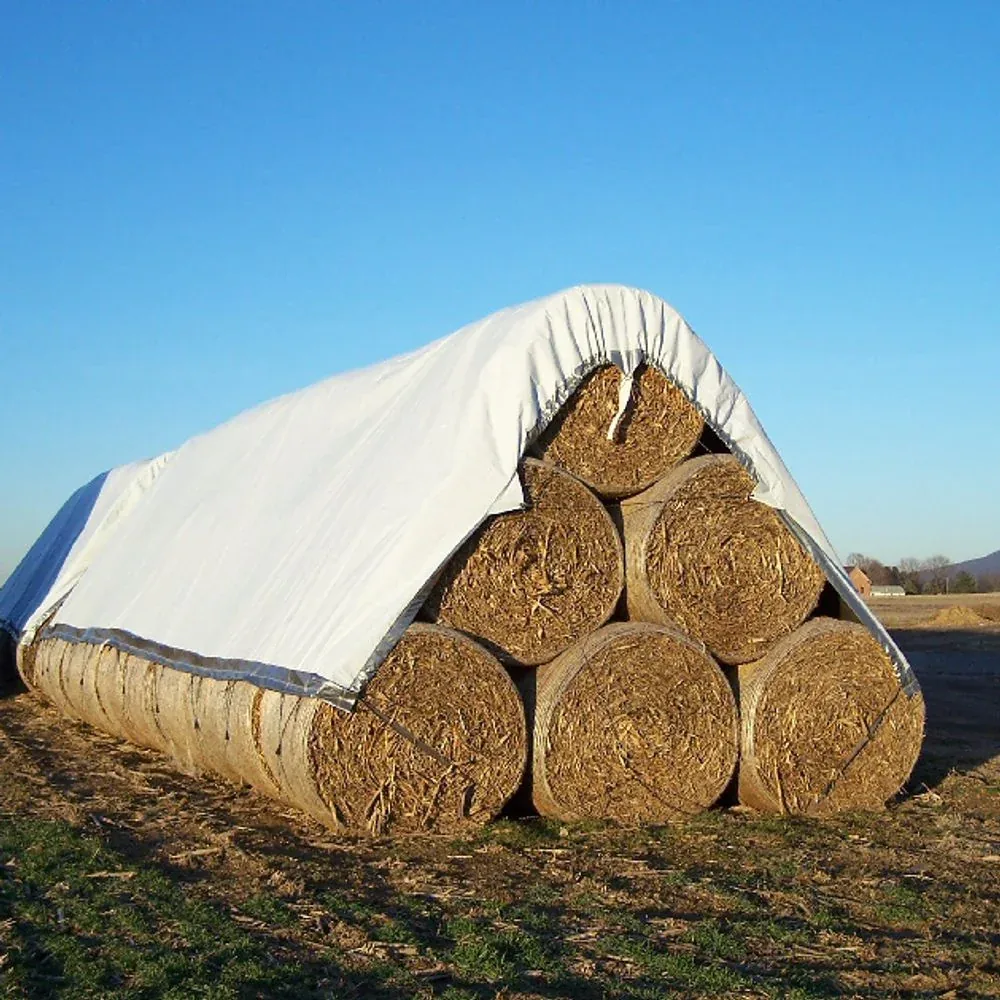
To choose a hay tarp size, measure the distance the cover must travel across the stack, then check the distance it must cover from one end to the other. Include the side coverage and end coverage required by your installation plan. Comparing these measurements with the supplier's confirmed finished dimensions is more reliable than choosing a tarp from bale count alone.
A stack's footprint is only part of the picture. Round bales create a curved profile, while rectangular bales may form a flat, stepped or sloping top. This guide explains what to measure and how to turn those measurements into a useful enquiry.
Measure the covering path across the stack
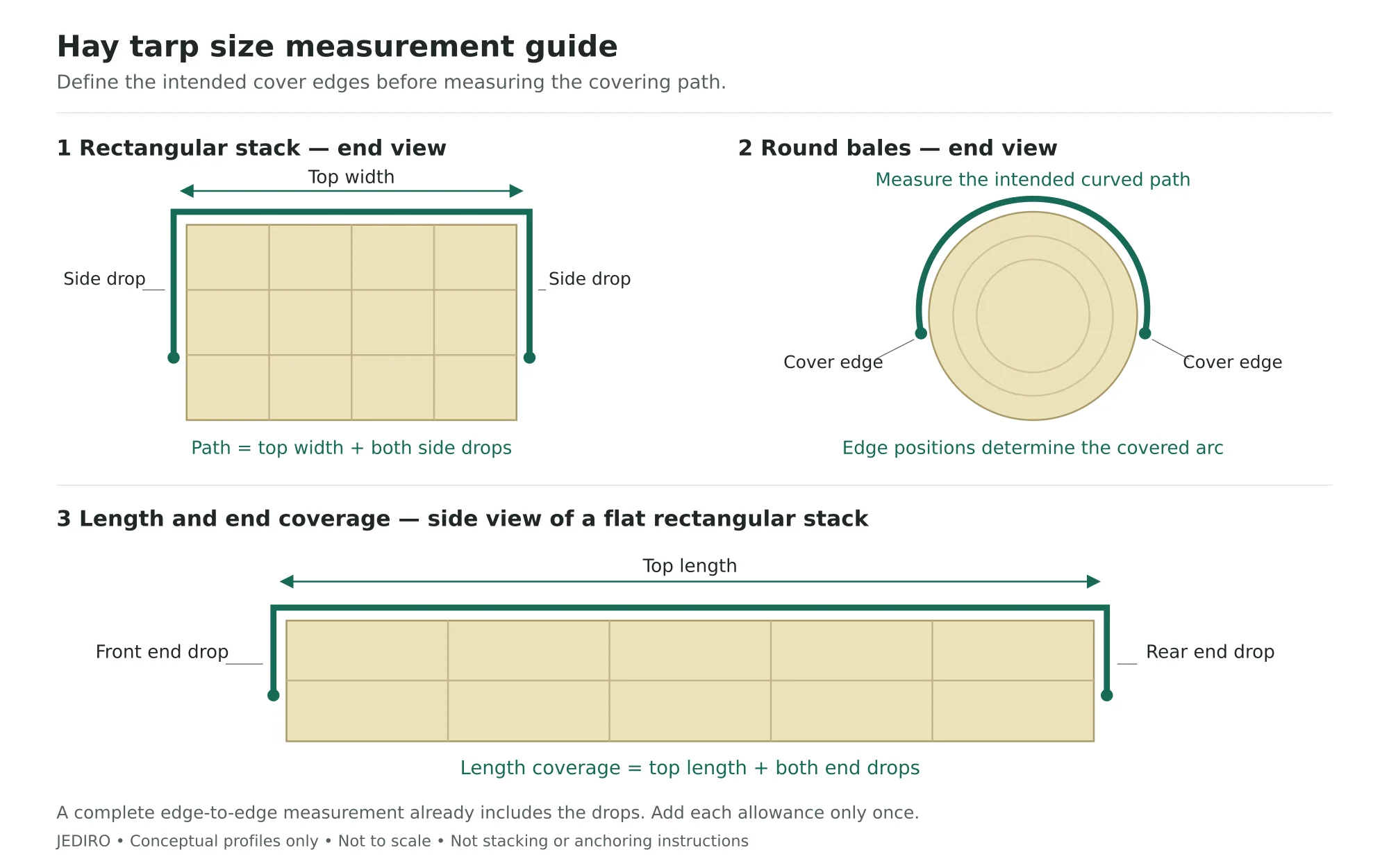
Start by deciding where you want the cover to finish on each side. The transverse covering path runs from one intended cover edge, over the stack's upper profile, to the intended edge on the opposite side. This path determines the fabric dimension needed across the stack.
If you measure that complete path, the side drops are already included. Do not add them again. If you measure only the top section, record each side drop separately and add it once.
For a simple, flat rectangular top, a preliminary calculation is:
Required transverse coverage = top width + left side drop + right side drop.
For a curved, pitched or stepped profile, use the intended covering path rather than treating the stack as a flat rectangle. A sketch helps show whether the cover follows a surface or spans between high points. Avoid assuming that a cover should dip into every gap between bales.
Measurements for round bale stacks
Record bale diameter, bale length, orientation, rows across the stack and the arrangement of any upper tiers. A single row and several tiers can contain the same number of bales but require different covers.
Measure the maximum overall stack length as well as the profile across it. Bale dimensions alone may not capture gaps, uneven ends or differences in placement. For repeated stacks, note any variation rather than assuming every stack matches the first.
Do not use a whole bale's circumference as a universal tarp width. The portion being covered depends on the arrangement and the selected edge positions. A supplier's bale-count chart is useful only when the bale dimensions, stack pattern and intended coverage match your own.
Collect measurements from a safe position using suitable equipment. Do not climb an unstable stack to take an over-stack measurement. Where direct measurement is impractical, provide an annotated sketch and discuss a suitable measuring method with the installer.
Measurements for square bale stacks
For square or rectangular bales, record individual bale dimensions and their orientation. Then measure the assembled stack's top width, overall length and height. Note any steps, raised centre section or uneven top.
On a flat top with vertical sides, the width-plus-side-drops calculation gives a useful starting point. If the top is pitched, the cover travels along a longer route than the horizontal width. Follow the intended profile in your calculation or measurement.
Measure length independently. For a level top, add the required coverage at the front and rear to the top length. If the longitudinal profile also rises or steps, measure that covering path rather than using ground length alone.
Define side and end allowances before ordering
There is no single side drop or end allowance suitable for every stack. The required coverage depends on the stack profile, weather exposure and the cover's attachment design. Agree where the edges will sit and how they will connect to the installation system.
Clarify whether an end allowance means fabric extending beyond the top edge, a vertical drop over the end face, or part of another arrangement. Record the intended coverage in a sketch so the buyer and supplier use the same definition.
Keep the installation system separate from fabric coverage. Rope length, ground-anchor positions and pipe dimensions are not automatically extra tarp dimensions. Confirm any fabric needed for hems or sleeves with the supplier as part of the finished design.
Buying a much larger cover also needs planning: surplus fabric must be managed with a compatible fastening arrangement. Check the fit and attachment layout together instead of selecting the largest available sheet.
A worked example for a flat rectangular stack
Suppose the measured top is 6.0 m wide and 13.0 m long. For this example only, the buyer's installation plan calls for a 1.2 m drop on each side and a 0.6 m drop at each end.
Swipe horizontally to view all columns.
| Coverage direction | Calculation | Required coverage |
|---|---|---|
| Across the stack | 6.0 + 1.2 + 1.2 m | 8.4 m |
| Along the stack | 13.0 + 0.6 + 0.6 m | 14.2 m |
A listed 28 ft × 48 ft tarp converts to approximately 8.53 m × 14.63 m, so it is a candidate for discussion. However, the shorter dimension exceeds the calculated requirement by only about 0.13 m. Confirm finished dimensions, tolerance, attachment positions and installation needs before treating it as a fit.
The example illustrates the arithmetic. Its allowances are not recommendations for other stacks, and the calculation does not establish anchoring capacity.
JEDIRO listed hay tarp sizes in feet and metres
The following size combinations appear in JEDIRO's hay tarp specification material. Metric values are conversions rounded to two decimal places. Use this guide alongside the hay tarp fabric-weight guide when preparing a complete quotation request.
Swipe horizontally to view all columns.
| Listed size in feet | Approximate size in metres |
|---|---|
| 30 ft × 48 ft | 9.14 m × 14.63 m |
| 15 ft × 54 ft | 4.57 m × 16.46 m |
| 15 ft × 48 ft | 4.57 m × 14.63 m |
| 28 ft × 48 ft | 8.53 m × 14.63 m |
| 43 ft × 60 ft | 13.11 m × 18.29 m |
| 28 ft × 60 ft | 8.53 m × 18.29 m |
Treat these as listed size options, not a bale-capacity chart. Confirm which dimension runs across your stack and which runs along it, including the orientation of sleeves or attachment points. Availability and the finished-size basis should be confirmed in the quotation.
Confirm cut size and finished size
A supplier may quote a cut size before edge fabrication or a finished size after hemming. Those descriptions are not interchangeable. Ask for the finished outer dimensions, the agreed tolerance and a drawing showing any sleeves or reinforced edges.
Do not assume a standard percentage reduction for every supplier. If the quote gives only a nominal size, request clarification before comparing it with your measurement sheet. Also check where the usable coverage ends and the attachment system begins.
Prepare a measurement sheet for your enquiry
Send the following information with a side photograph and an end photograph taken from safe positions. Mark the desired cover edges on a sketch.
Swipe horizontally to view all columns.
| Enquiry field | Information to provide |
|---|---|
| Bale type and size | Round bale diameter and length, or rectangular bale dimensions |
| Stack arrangement | Bale orientation, rows across, tiers and top profile |
| Stack dimensions | Maximum overall length, width and height |
| Transverse covering path | Edge-to-edge path over the stack; state whether side drops are included |
| Longitudinal covering path | Path along the stack; state whether end coverage is included |
| Intended coverage | Desired side and end edge positions |
| Installation system | Proposed fasteners, sleeves, pipes or other attachment details |
| Order requirements | Quantity, destination and required delivery timing |
Once the required cover size is clear, use the hay tarp reinforcement guide to record the hem, eyelet, webbing-loop and pipe-sleeve details that should accompany your enquiry.
Frequently asked questions
Can I choose a hay tarp by bale count alone?
Bale count does not define the stack profile. Include bale dimensions, orientation and arrangement, then compare the required covering paths with the confirmed tarp dimensions.
Is the listed tarp size always the finished size?
Check the quotation. Ask whether the stated dimensions refer to cut fabric, nominal size or the finished tarp, and agree the applicable tolerance.
How much side coverage should I allow?
Set the edge positions with the supplier or installer for your stack and fastening system. There is no universal side-drop figure. An over-stack measurement taken between the intended cover edges already includes those drops.
Does a correctly sized top cover protect against ground moisture?
Ground moisture needs separate management. University of Minnesota Extension recommends a well-drained storage surface and measures to limit direct contact between hay and the ground. Include site drainage and the stack base in your storage plan.
Send JEDIRO your stack dimensions, bale arrangement, intended side and end coverage, quantity and destination. We can discuss the required cover size and confirm the supply specification for your quotation.
View JEDIRO hay tarp options or contact JEDIRO with your measurement sheet.
Frequently Asked Questions
Featured Product
Discuss Your Required Cover Size
Share your stack dimensions, bale arrangement, intended coverage, quantity, and destination so JEDIRO can discuss the required cover size and confirm the supply specification for your quotation.
Related Articles
Share this article
JEDIRO Team
We manufacture bale net wrap, silage wrap film, and cotton wrap film for global agricultural markets. Learn more about us →