
Moisture Under a Hay Tarp: Rain Leaks, Ground Dampness and Condensation
By JEDIRO Team
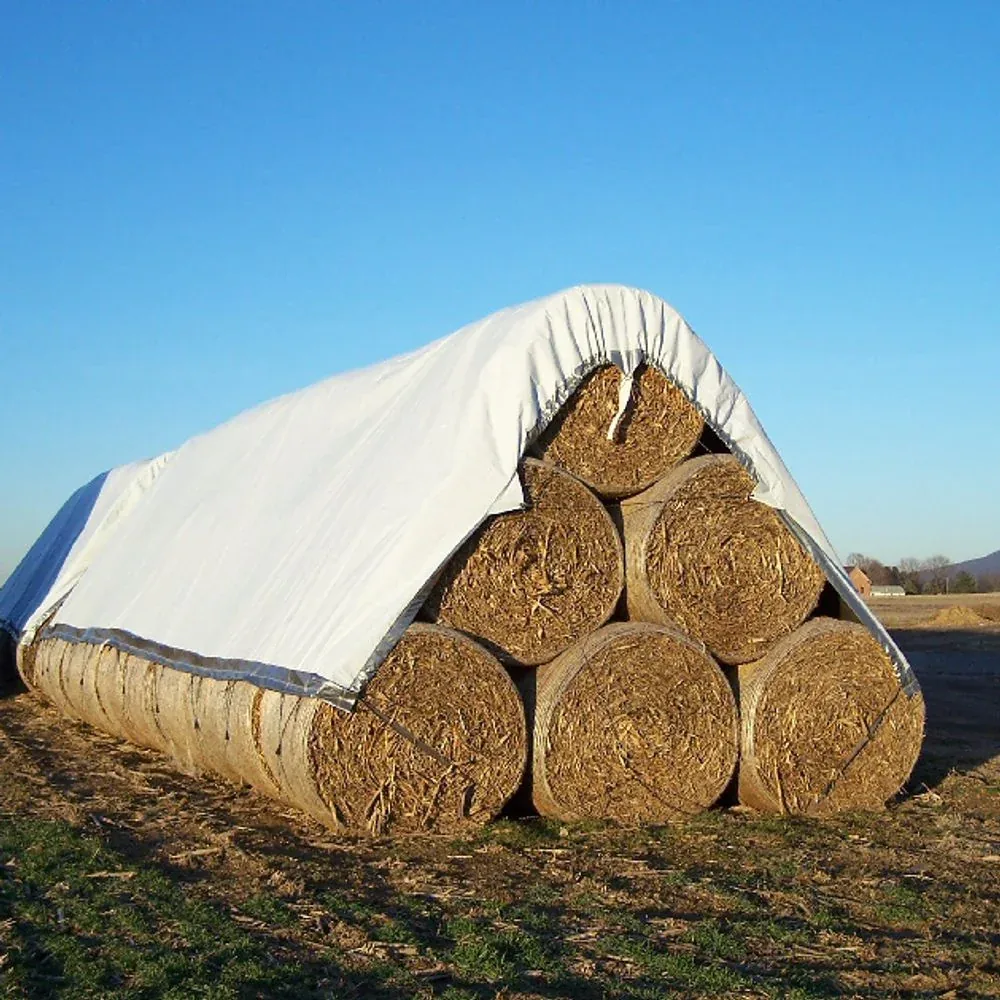
Moisture under a hay tarp comes from one of three places: rain or melt water that gets in, moisture rising from the ground, or condensation and humidity from the hay itself. They can look alike, and a waterproof cover only addresses the first. A cover does not dry hay that went into the stack damp, and it does not stop moisture wicking up from wet ground. Find where the wetness appears before deciding that the tarp leaks.
Three Moisture Sources That Can Look Similar
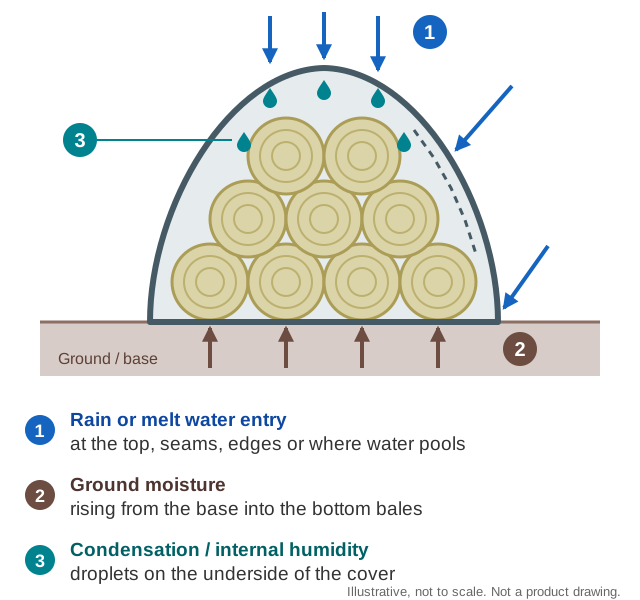
University of Minnesota Extension says molds and bacteria cause most storage losses and grow faster in warm, moist hay, so controlling moisture is probably the best strategy. Under a cover, moisture can reach hay in three ways.
Rain or melt water entry. Water can get in through damage, open seams, edge gaps or places where it pools on the cover. Minnesota Extension notes that rain and melted snow can rewet hay enough to support mold. In its Morris, Minnesota study of uncovered bales, the clearest mold appeared where water ran from an upper bale onto a lower one.
Ground moisture. Bales resting directly on the ground absorb enough moisture to grow mold. In the same study, third-cutting alfalfa was baled at about 18 percent moisture in September 1996 and stored for about eight months. Bottom bales stored uncovered on sod had risen to about 32 percent by mid-June. That is one study, one site and one type of hay. It does not predict your results and is not a JEDIRO performance figure.
Condensation and internal humidity. Large bales do not lose much moisture after baling, and microbial activity adds heat. Where warm, humid air meets a cooler cover surface, water can condense as droplets on the underside. Manitoba Agriculture's tarping guidance—not JEDIRO installation guidance—refers to condensation from stack “sweating.” In that guidance, Manitoba Agriculture recommends a peaked stack top and open stack ends so moisture can escape. JEDIRO does not present keeping stack ends open as a product-installation instruction; use local guidance and site-specific advice.
Check Where the Wetness Appears
Location is a clue, not a diagnosis, and more than one source can act at once. Inspect from the ground or another safely accessible position. Do not climb an unstable stack or pull a cover off it. If a stack feels hot or smells musty or burnt, it may be heating; Minnesota Extension notes that in extreme cases this can cause fires, so get qualified local advice before opening or moving it.
Swipe horizontally to view all columns.
| What you see | Check first | Do not conclude yet |
|---|---|---|
| Bottom layer wetter than the upper layers | Ground contact, base drainage, and surface water running toward the stack | That the cover is leaking |
| Wet marks at seams, folds or low points | Pooled water, damage, seam and edge condition, and the slope of the cover | That the fabric is faulty, based on one photograph |
| Droplets on the underside of the cover | Moisture already in the hay, temperature differences, and how moist air can leave | That rain has come through the fabric |
| Wetness along the sides or lower edge | How far the cover reaches down the stack, and where runoff drains | That the fabric has failed |
| Dampness or mold spread through the stack, including inside bales | Hay moisture at baling, storage time and site conditions | That the cover alone caused it |
Why a Waterproof Cover Does Not Dry Wet Hay
A cover can keep rain off dry hay. It cannot remove moisture already inside the bales. Minnesota Extension stresses baling at the proper moisture rather than counting on drying in storage. The right level depends on hay type, bale type and storage time, so follow local extension guidance and measure moisture with suitable equipment.
JEDIRO supplies hay tarps made from polyethylene (PE) fabric. They are intended to reduce direct rain and sunlight exposure on outdoor stacks. We do not publish a moisture-vapour permeability figure for the PE hay tarp, and we do not present it as a way to dry wet hay.
The same applies to mildew resistance. A cover described as mildew-resistant is describing the cover material, not the moisture or mold risk inside the hay.
Separate Ground Protection from Top Covering
Ground protection and top covering solve different problems. Minnesota Extension recommends preventing direct contact between the ground and the bottom bales, for example with coarse gravel, old tires or pallets, and advises against storing bales under trees. Its Morris study compared bales uncovered on the ground, uncovered on gravel and covered on gravel, because the base and the cover each change the outcome.
A tarp does not create a drained base, and a drained base does not keep rain off the top. Arrange the cover so water runs off without pooling or flowing back toward the base. For site preparation, see five common mistakes when storing round bales outdoors.
Match Cover Selection to Moisture Management
A PE hay tarp suits a specific job: shedding rain and reducing sun exposure on hay stored at a suitable moisture on a drained base. It does not fix hay that was baled wet, a poorly drained site or a need for documented moisture-vapour performance. Some suppliers market breathable covers, which are a different material approach; ask each supplier for the evidence behind its claims.
If a PE cover fits, size and secure it so water drains away. The hay tarp size guide explains side and end coverage, and the reinforcement guide covers hems, eyelets and pipe sleeves. After strong wind or rain, recheck from a safe position for slack fabric, pooling water and damaged attachment points.
Sources: University of Minnesota Extension, “Preserving the value of dry stored hay” (page shows review in 2018; includes the Morris, Minnesota storage study); Manitoba Agriculture, “Tips for Tarping and Shedding Quality Cash Hay”. The open-stack-ends suggestion cited above is Manitoba Agriculture guidance, not a JEDIRO installation instruction. Product statements about JEDIRO hay tarps are based on the JEDIRO hay tarp product page.
Frequently Asked Questions
Featured Product
Check Whether a PE Hay Tarp Fits Your Site
Describe your storage site and covering requirements so we can clarify whether a PE hay tarp fits your application.
Related Articles


Share this article
JEDIRO Team
We manufacture bale net wrap, silage wrap film, and cotton wrap film for global agricultural markets. Learn more about us →